Funeral and memorial piano music
Music often played at funerals and memorial services, to read at the keyboard: Bach's Jesu, Joy of Man's Desiring, Handel's Largo, Schubert's Ave Maria, Chopin's funeral marches and hymns often sung at funerals. Chopin's Prelude in E minor was played at his own funeral; Bach's Prelude in C is the accompaniment over which Gounod later set his Ave Maria; Liszt and Burgmüller each wrote a Consolation; and the hymns run from Amazing Grace and Rock of Ages to O God, Our Help in Ages Past and Guide Me, O Thou Great Jehovah. Each piece has versions with fewer notes made from the score itself, starting with the melody alone.
- Pieces
- 17
- Levels
- 3 to 5
- Key signatures
- 3 flats to 4 sharps
- Length
- 8 to 92 bars
Choosing music for a service
A service usually has music in three places: while people arrive, during the service (a hymn, or a piece while people sit quietly), and as they leave. Ask the family whether a piece meant something to the person, and ask the officiant or the venue how long each place is and whether there is a piano.
Each piece here says roughly how long it plays as its score is written: a range, from a little quicker to a little slower than the speed the score gives, since players take these pieces at their own pace, and a recording can run longer where it plays a repeat or a return the score leaves out. Time yourself at the speed you will play before you plan by it. Most can be shortened: end at the close of a section, or leave out a repeat. For a hymn people sing, play the tune once as an introduction, then once for each verse; played on its own, once or twice through is enough. Music while people arrive can run as long as it needs: a hymn tune or the Largo can be played again from the start and stopped at the end of any phrase.
Play the version you can play calmly. A melody with a simple left hand, played steadily, serves the service better than the full score played under strain, and no one listening will mind which version is on the stand. Open a piece to print its versions with fewer notes, choose one, and practise it at the speed you will play on the day.
Level 3
Both hands busy, the hand moves around, a sharp or flat or two.
-
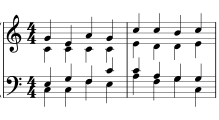 O God, Our Help in Ages Past
William Croft no sharps or flats, 4/4, 8 bars Community source
plays in about 25 seconds as written -
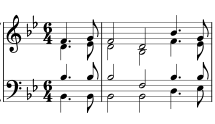 Rock of Ages, Cleft for Me
Thomas Hastings 2 flats, 6/4, 11 bars Community source
plays in about 55 seconds as written -
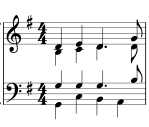 Guide Me, O Thou Great Jehovah
John Hughes 1 sharp, 4/4, 14 bars Community source
plays in about 40 seconds as written -
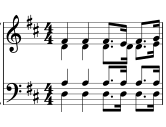 Shall We Gather at the River
Robert Lowry 2 sharps, 4/4, 16 bars Community source
plays in about 40 seconds as written -
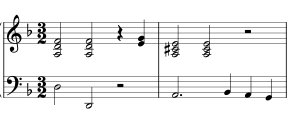 Sarabande, HWV 437
George Frideric Handel 1 flat, 3/2, 16 bars Community source
plays in 1 to 2 min as written -
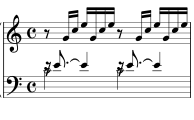 Prelude in C, BWV 846
Johann Sebastian Bach no sharps or flats, 4/4, 35 bars Two sources agree
plays in 1 to 2 min as written -
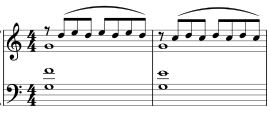 Consolation, Op. 100 No. 13
Friedrich Burgmüller no sharps or flats, 4/4, 27 bars Community source
plays in 1 to 2 min as written -
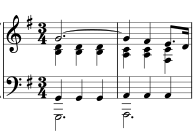 Largo (Ombra mai fu), from Serse
George Frideric Handel 1 sharp, 3/4, 52 bars Community source
plays in 2 to 4 min as written -
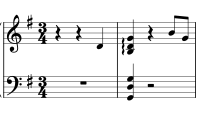 Amazing Grace
Traditional 1 sharp, 3/4, 87 bars Community source
plays in 2 to 4 min as written -
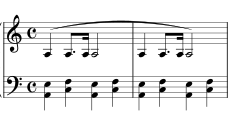 Funeral March, from the Sonata No. 2
Frédéric Chopin no sharps or flats, 4/4, 92 bars Community source
plays in 8 to 14 min as written
Level 4
Real independence between the hands and more accidentals.
-
 O Love That Wilt Not Let Me Go
Albert Lister Peace 3 flats, 4/4, 10 bars Community source
plays in about 30 seconds as written -
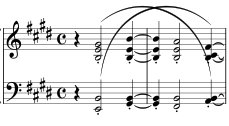 Consolation No. 1
Franz Liszt 4 sharps, 4/4, 25 bars Community source
plays in 1 to 2 min as written -
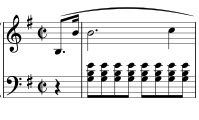 Prelude in E minor, Op. 28 No. 4
Frédéric Chopin 1 sharp, 2/2, 25 bars Two sources agree
plays in 1 to 2 min as written -
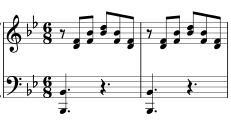 Ave Maria
Franz Schubert 2 flats, 6/8, 65 bars Community source
plays in 1 to 3 min as written -
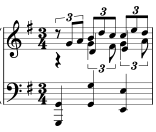 Jesu, Joy of Man's Desiring
Johann Sebastian Bach 1 sharp, 3/4, 71 bars Checked against the edition
plays in 2 to 4 min as written -
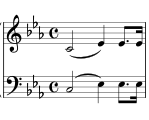 Funeral March in C minor, Op. 72 No. 2
Frédéric Chopin 3 flats, 4/4, 76 bars Community source
plays in 2 to 5 min as written
Level 5
The edge of early intermediate: dense textures, fast passages and far keys.
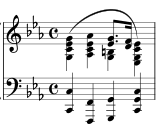
Open a piece to print any of its versions free, or to play it at your MIDI keyboard with every note marked. New to reading? The level 2 sight-reading exercises are a good warm-up.
Learning with someone? Send them this page by email