Easy classical piano pieces that sound hard
Pieces at level 3 that sound like more than they ask: they run fast or range across the keyboard, while what you read stays at an early level. Here are 16, among them Mozart's Rondo alla turca (Turkish March); Grieg's Morning Mood, from Peer Gynt; and Schubert's Waltz, D. 969 No. 9. Each has easier versions made from the score itself, so you can learn the melody first and play it as written later.
- Pieces
- 16
- Level
- 3
- Key signatures
- 3 flats to 3 sharps
- Length
- 17 to 111 bars
How these were chosen: every piece in the library at level 2 or 3 that is faster or wider than three pieces in four across the whole library. Fast means more than 9 notes a second at the tempo the score marks; wide means more than 4 octaves from its lowest note to its highest. Numbered exercises are left out; they are on the studies page.
Level 3
Both hands busy, the hand moves around, a sharp or flat or two. Most of the Notebook minuets, sonatinas, The Entertainer.
-
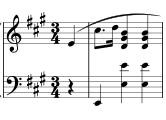 Prelude in A, Op. 28 No. 7
Frédéric Chopin 3 sharps, 3/4, 17 bars
spans more than 4 octaves of the keyboard -
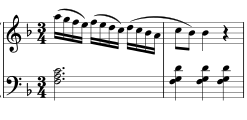 Innocence, Op. 100 No. 5
Friedrich Burgmüller 1 flat, 3/4, 32 bars
spans more than 4½ octaves of the keyboard; no stretch wider than an octave -
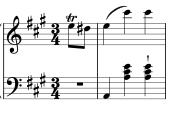 Waltz, Op. 32 No. 1
Carl Czerny 3 sharps, 3/4, 33 bars
spans more than 4½ octaves of the keyboard, about 10 notes a second at its marked tempo; no stretch wider than an octave -
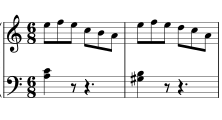 Presto, from the Sonata in A minor
Georg Benda no sharps or flats, 6/8, 36 bars
spans more than 4½ octaves of the keyboard; no stretch wider than an octave -
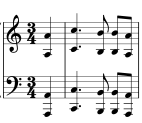 Waltz, D. 969 No. 9
Franz Schubert no sharps or flats, 3/4, 37 bars
spans more than 5 octaves of the keyboard, about 13 notes a second at its marked tempo; no stretch wider than an octave -
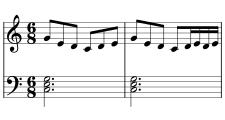 Morning Mood, from Peer Gynt
Edvard Grieg no sharps or flats, 6/8, 38 bars, shortened
spans more than 4 octaves of the keyboard; no stretch wider than an octave -
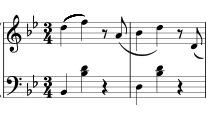 Träumerei
Cornelius Gurlitt 2 flats, 3/4, 44 bars
spans more than 4 octaves of the keyboard; no stretch wider than an octave -
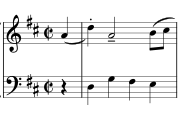 March in D
Carl Philipp Emanuel Bach 2 sharps, 2/2, 45 bars
spans more than 4 octaves of the keyboard; no stretch wider than an octave -
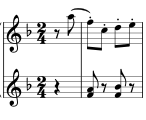 Allegro scherzando in F
Haydn 1 flat, 2/4, 54 bars
spans more than 4½ octaves of the keyboard; no stretch wider than an octave -
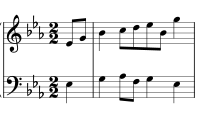 March in E flat, BWV Anh. 127
Anonymous 3 flats, 2/2, 57 bars
spans more than 4 octaves of the keyboard; no stretch wider than an octave -
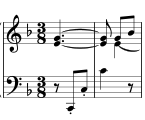 The Chatterbox, Op. 100 No. 17
Friedrich Burgmüller 1 flat, 3/8, 58 bars
spans more than 4 octaves of the keyboard; no stretch wider than an octave -
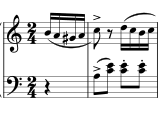 Rondo alla turca (Turkish March)
Wolfgang Amadeus Mozart no sharps or flats, 2/4, 65 bars, shortened
about 11 notes a second at its marked tempo; no stretch wider than an octave -
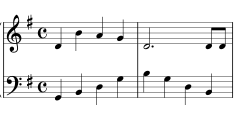 Jingle Bells
James Pierpont 1 sharp, 4/4, 66 bars
spans more than 4½ octaves of the keyboard; no stretch wider than an octave -
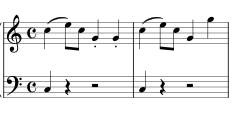 Sonatina in C, Op. 36 No. 1: I
Muzio Clementi no sharps or flats, 4/4, 76 bars
spans more than 4 octaves of the keyboard; no stretch wider than an octave -
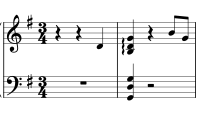 Amazing Grace
Traditional 1 sharp, 3/4, 87 bars
spans 5 octaves of the keyboard -
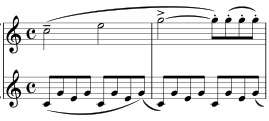 Sonatina in C, Op. 20 No. 1: Allegro
Friedrich Kuhlau no sharps or flats, 4/4, 111 bars
spans more than 5 octaves of the keyboard; no stretch wider than an octave
Open a piece to print any of its versions free, or to play it at your MIDI keyboard with every note marked. New to reading? The level 2 sight-reading exercises are a good warm-up.