Bach's two-part inventions
Bach's two-part inventions, easiest first: No. 1 in C at level 3, most of the rest at level 4, and No. 9 in F minor at level 5. Each is a page or two for two equal voices, the usual step after the Little Preludes and before the three-part sinfonias and the suites. Each has easier versions made from the score itself (the right-hand melody alone, then with left-hand roots), so you can start a step down and play it as written later.
- Pieces
- 13
- Levels
- 3 to 5
- Key signatures
- 4 flats to 4 sharps
- Length
- 20 to 124 bars
Reading an invention
Bach wrote the fifteen two-part inventions in 1723 for his pupils, to teach them to play two voices cleanly and, in the words of his title page, to arrive at a singing style. Each takes a short motif and passes it between the hands: one hand states it, the other answers with it a few beats later, and the whole piece is built from that motif moved to other pitches, turned upside down and set against itself.
Read the first bar until you know the motif by sight; after that, much of the page is the same shape in the other hand or at another pitch. Neither hand is the accompaniment, so practise each alone first (a piece's ladder here starts that way), then together slowly. No. 1 in C is the usual first; No. 8 in F and No. 13 in A minor are often next.
Level 3
Both hands busy, the hand moves around, a sharp or flat or two.
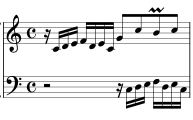
Level 4
Real independence between the hands and more accidentals.
-
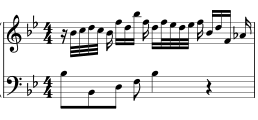 Invention No. 14 in B flat, BWV 785
Johann Sebastian Bach 2 flats, 4/4, 20 bars -
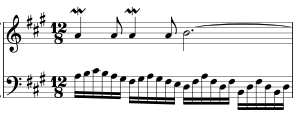 Invention No. 12 in A, BWV 783
Johann Sebastian Bach 3 sharps, 12/8, 21 bars -
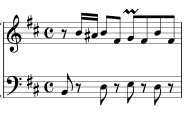 Invention No. 15 in B minor, BWV 786
Johann Sebastian Bach 2 sharps, 4/4, 22 bars -
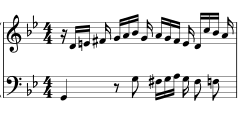 Invention No. 11 in G minor, BWV 782
Johann Sebastian Bach 2 flats, 4/4, 23 bars -
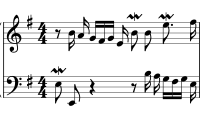 Invention No. 7 in E minor, BWV 778
Johann Sebastian Bach 1 sharp, 4/4, 23 bars -
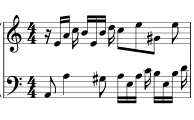 Invention No. 13 in A minor, BWV 784
Johann Sebastian Bach no sharps or flats, 4/4, 25 bars -
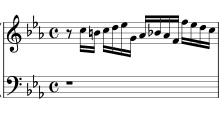 Invention No. 2 in C minor, BWV 773
Johann Sebastian Bach 3 flats, 4/4, 27 bars -
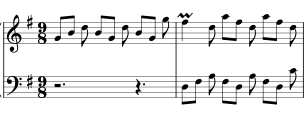 Invention No. 10 in G, BWV 781
Johann Sebastian Bach 1 sharp, 9/8, 32 bars -
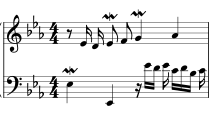 Invention No. 5 in E flat, BWV 776
Johann Sebastian Bach 3 flats, 4/4, 32 bars -
 Invention No. 8 in F, BWV 779
Johann Sebastian Bach 1 flat, 3/4, 34 bars -
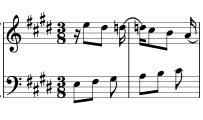 Invention No. 6 in E, BWV 777
Johann Sebastian Bach 4 sharps, 3/8, 124 bars
Level 5
The edge of early intermediate: dense textures, fast passages and far keys.
Open a piece to print any of its versions free, or to play it at your MIDI keyboard with every note marked. New to reading? The level 2 sight-reading exercises are a good warm-up.